
Institutional Confinement & Absorption Matrix
In retail technical analysis, traders draw horizontal lines at single candle wicks. The AlphaEdge Box Theory Matrix defines an institutional accumulation zone as a mathematical 3-tier boundary developed from volume distribution and delivery volume on the National Stock Exchange of India (NSE).
The Confinement Phase
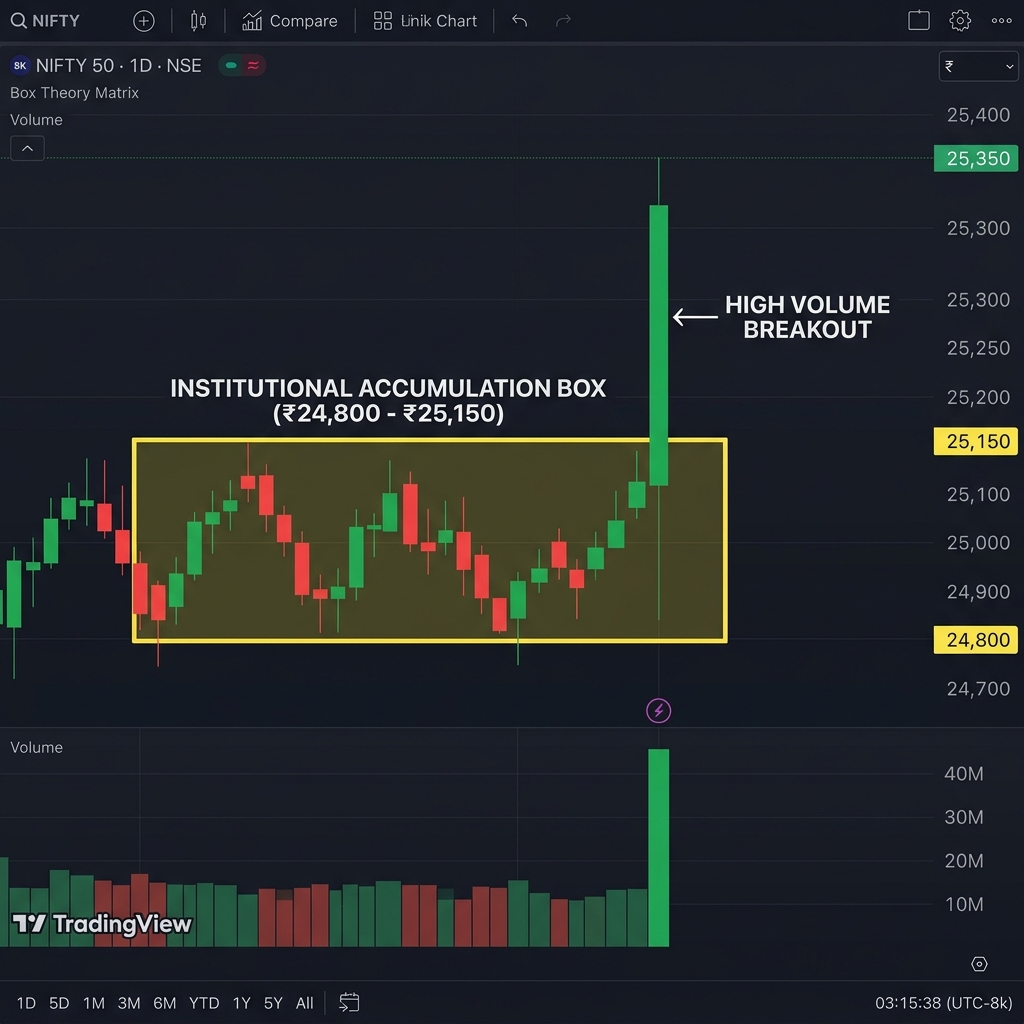
Price oscillates within the 350-point boundary. Big institutions absorb selling pressure at the floor (₹24,800) and absorb buyer eagerness at the ceiling (₹25,150), building massive inventory over several trading sessions without letting spot price trend.
The Energy Coil
As the box matures, daily trading volume on NSE cash & futures steadily dries up. Intraday ranges narrow from 180 points to under 70 points. This drying volume proves that floating supply has been fully locked up by institutions.
The Breakout Ignition
Once absorption is complete, a high-volume institutional expansion candle breaks beyond the box boundary. In index options, this unleashes an immediate gamma expansion as trapped range sellers are forced into rapid stop-loss short covering.
NIFTY 50 Institutional Box Matrix Chart
Real-time market structure showing the 24,800 – 25,150 confinement box followed by the high-volume explosive breakout candle reaching ₹25,350+ on NSE India.
Option Straddle / Strangle Compaction
The true secret of trading Box Theory in Indian indices lies in understanding the At-The-Money (ATM) option straddle premium. When spot price is confined within the box, institutional options desks sell the straddle to milk theta decay.
The Premium Compaction Cycle
When NIFTY 50 trades inside the ₹24,800 – ₹25,150 box, the ATM 25,000 Straddle (25000 CE + 25000 PE) compresses relentlessly. Premiums erode from ₹360 combined down to ₹180 combined as Implied Volatility (IV) collapses.
Range traders must avoid buying naked options during this compaction stage because time decay destroys capital regardless of small intraday swings.
The Volatility Expansion Release
When price closes decisively outside the box (e.g. above ₹25,150), the call side of the straddle undergoes explosive gamma acceleration. Straddle sellers are forced into panic short-covering, adding intense institutional fuel to the directional breakout.
Buying slightly in-the-money (ITM) options at the exact moment of box breakout produces a 100% to 250% return in under 90 minutes.
Core Quantitative Laws of the Box Matrix
- Rule of 3 Touches: A valid box requires at least 2 distinct touches at the ceiling and 2 distinct touches at the floor over a minimum period of 3 trading sessions on the 75-minute chart.
- Volume Divergence Confirmation: Volume during the confinement period MUST decline. If volume expands while price is inside the box, the range is unstable and distribution is taking place.
- The 15-Minute Close Filter: Never front-run an intraday wick. An institutional breakout is ONLY confirmed when a 15-minute candle closes entirely outside the box threshold with volume exceeding 150% of the 20-period moving average.
Identifying False Breakouts (Bull & Bear Traps)
Retail traders lose significant capital because operators intentionally engineer false breakouts at the boundaries of the box to trigger retail stop orders and grab liquidity.
Ceiling Rejection & Fake-Out
NIFTY spikes above ₹25,150 during opening 9:15–9:30 AM volatility, triggering breakout buy orders from retail screeners. However, volume is low and the 15-minute candle leaves a long upper wick, closing back down at ₹25,130.
Floor Sweep & Swift Reclaim
NIFTY opens with a gap-down below ₹24,800 down to ₹24,760. Retail stop-losses trigger and panic sellers exit. Instantly, massive institutional limit buy orders absorb the float, driving the price back above ₹24,800 within 20 minutes.
NIFTY 50 Index: Step-by-Step Worked Blueprint
Study how an institutional trader executes the Box Theory Matrix on the National Stock Exchange of India with exact price and options premium values.
Trade Scenario: NIFTY 50 Weekly Option Breakout
Map the Indian Index Box
Over 4 sessions, NIFTY 50 establishes clear resistance at ₹25,150 and support at ₹24,800. Height of the box is exactly 350 points. Daily NSE cash volume drops 30% below average.
The 15-Min Breakout Close
At 11:45 AM, NIFTY prints a strong bullish marubozu candle closing at ₹25,185. The 15-min volume bar spikes to 42M, well above the 20-period average of 18M. Breakout confirmed!
Select the Liquid ITM Option
Select the NIFTY 25150 CE weekly option contract trading at ₹145.00. Stop-loss is placed at ₹105.00 (spot equivalent of ₹25,130). Risk per lot (25 qty) = ₹1,000.
Box Height Extension 1
Target 1 = Box Top + (0.618 × Height) = ₹25,150 + 216 pts = ₹25,366. NIFTY rallies into the afternoon session reaching ₹25,370. The 25150 CE surges from ₹145 to ₹275.00 (+89% gain).
100% Measured Move Target
Target 2 = Box Top + Box Height = ₹25,150 + 350 pts = ₹25,500. Trailer stop placed at breakeven. Option hits ₹365.00 for a +151% gain before market close.
Risk-to-Reward Ratio: 1:5.5
Total risk per lot: ₹1,000. Total gain realized: ₹5,500 per lot. The systematic box geometry eliminated guesswork and protected the trader from false noise.
Institutional Checklist: Before You Enter Any Box Trade
1. Is the box at least 3 sessions old? • 2. Did volume contract inside the box? • 3. Is the breakout candle a full 15-min close outside the box? • 4. Is the stop-loss strictly placed inside the box boundary?
Return to Academy Dashboard →